

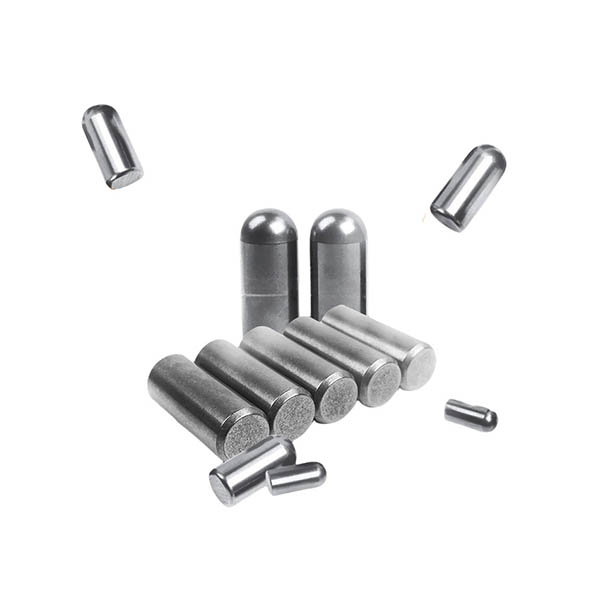
Roller Press Studs
WC-Co / WC-Cr Alloy Studs for HPGR Surface — Cylindrical / Bullet / Conical Profiles — Interference Fit + Hardfacing Underlay Installation
Roller Press Studs
Material Specifications & Selection Guide
| Grade | Material | Hardness | Carbide | Impact | Application |
|---|---|---|---|---|---|
| Cr-Mo Standard | Cr12-15% + Mo | 55-60 HRC | Medium | Moderate | Cement raw meal grinding |
| High Cr-Ni | Cr20-24% + Ni | 58-65 HRC | High | Low-Moderate | Coal / silica abrasive ore |
| Ultra Cr-Ni-Mo | Cr24-28% + Mo | 62-68 HRC | Very High | Low | Hard rock / iron ore |
| Cr-Ni-Nb | Cr18-22% + Nb | 56-62 HRC | High | Moderate | High-temp zones (300C+) |
| WC Composite | WC + Co Matrix | HRA 86-89 | Tungsten | Low | Extreme abrasion mining |
| Diameter (mm) | Length (mm) | Head Type | Pattern | Spacing (mm) | Application |
|---|---|---|---|---|---|
| 10-12 | 25-40 | Round | Helix | 15-20 | Small VRM rollers |
| 14-16 | 35-50 | Round | Helix / Straight | 18-25 | Standard RP rollers |
| 18-20 | 45-60 | Round / Flat | Herringbone | 22-30 | HPGR heavy duty |
| 22-25 | 55-75 | Round | Interlock | 28-35 | Mining HPGR |
| 28-32 | 65-90 | Flat / Round | Dot / Random | 35-45 | Severe impact zones |
| Parameter | Standard Studs | WC Composite | Notes |
|---|---|---|---|
| Welding Method | Manual SMAW | GTAW / PTA | Preheating required |
| Preheat (C) | 150-200 | 100-150 | Preheat roller surface |
| Current (A) | 120-180 | 80-140 | Match stud size |
| Interpass (C) | <250 | <200 | Control heat buildup |
| Post-Weld | Slow cool | None | Avoid thermal shock |
| Inspection | Visual + Hammer | PT + Visual | Check bonding |
Selection Quick Reference
- Cement raw meal / standard cement grinding (moderate wear): Cr-Mo Standard studs (55-60 HRC, 14-16 mm dia.) with helix pattern — cost-effective for normal cement applications with 15-20 mm spacing
- Coal grinding / silica abrasive materials (high abrasion): High Cr-Ni studs (58-65 HRC, 16-20 mm dia.) with herringbone pattern — higher carbide content resists abrasive silica, interlocking pattern prevents shelling
- Iron ore / hard rock HPGR (severe abrasion): Ultra Cr-Ni-Mo studs (62-68 HRC, 18-25 mm dia.) with interlock pattern — maximum hardness for mining applications, limited impact resistance
- Kiln feed / high-temperature zones (thermal cycling): Cr-Ni-Nb studs (56-62 HRC, 14-18 mm dia.) — niobium stabilizes carbides at elevated temperatures above 300 C
- Extreme mining / diamond ore (maximum wear): WC Composite studs (HRA 86-89, 10-16 mm dia.) — tungsten carbide provides exceptional wear resistance, use dot pattern for impact distribution
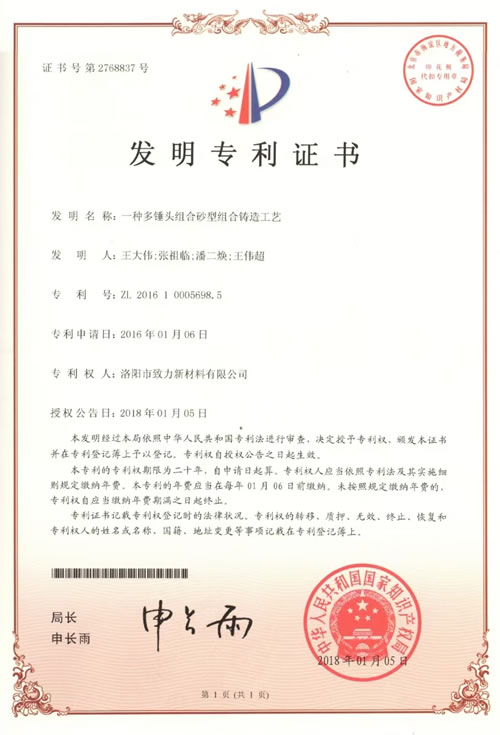
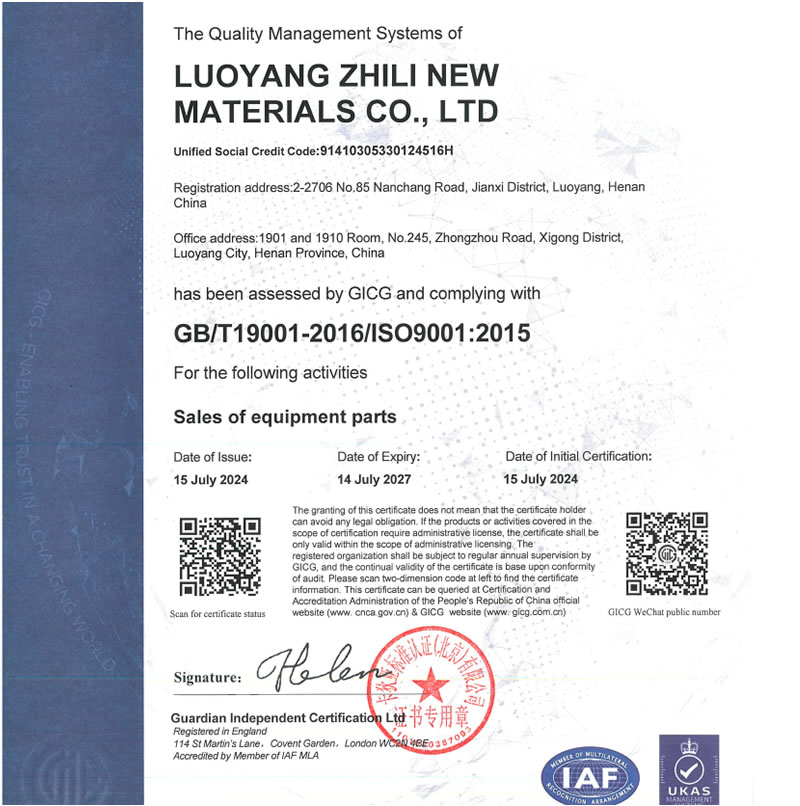
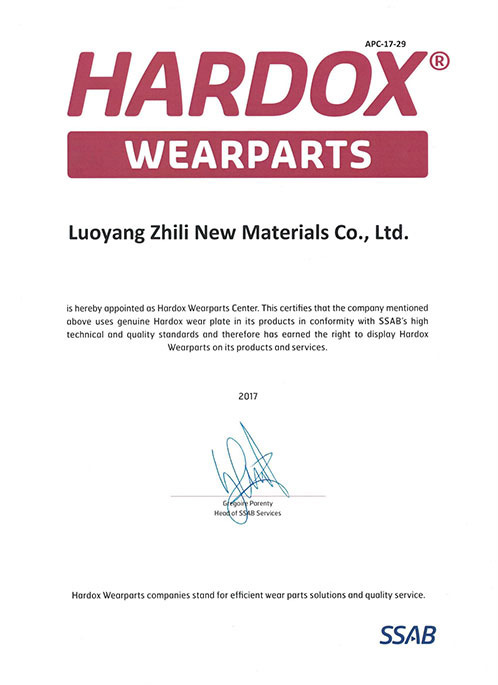
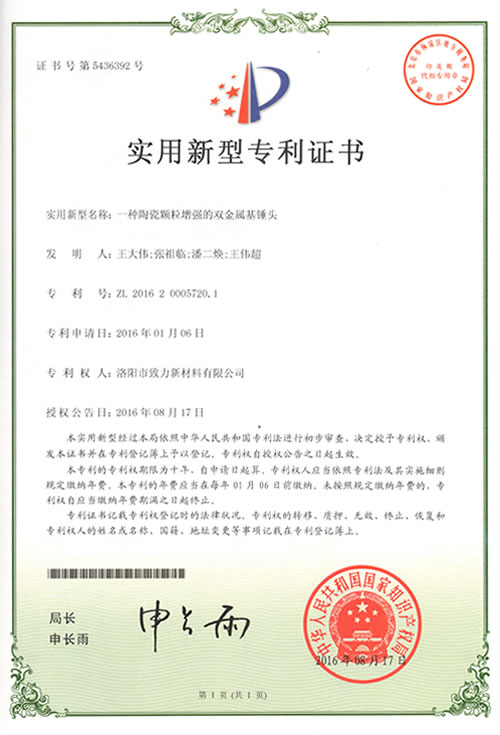
Certifications & Authorizations
Quality you can verify. Partners you can trust.
Custom OEM / ODM
From drawing to delivery — one-stop customization, no minimum order
Send Drawing
Upload your technical drawing (PDF, DWG, STEP, IGES) or share sample photos with dimensions
Engineering Review
Material recommendation, casting process design, DFM analysis — free quotation within 24 hours
Sampling & Test
Prototype production with full inspection: hardness test, spectrometer, dimensional check
Production & Ship
ISO 9001 certified. 15-25 days standard lead time. Global shipping with full documentation
Frequently Asked Questions
Roller Press Studs — WC-Co / WC-Cr Cemented Carbide Inserts for HPGR
The binder metal in cemented carbide studs determines the balance between wear resistance and impact toughness. Choosing wrong wastes money or causes premature stud failure.
WC-Co (Cobalt Binder)
6-10% Co content
TRS: 2,200-3,500 MPa
Hardness: HRA 86-91
Wear mechanism: Co is a tough, ductile metal that absorbs impact energy without fracturing. WC grains stay locked in Co matrix under shock loading.
Best for: Hard rock, tramp metal risk, variable feed
Cost: Higher (Co is $30-40/kg)
WC-Cr (Chromium Binder)
8-12% Cr content
TRS: 1,800-2,200 MPa
Hardness: HRA 85-88
Wear mechanism: Cr forms Cr-CrC carbides at grain boundaries. Carbide binder is harder but brittle — cracks propagate through Cr-carbide bridges under impact.
Best for: Consistent cement clinker, clean feed
Cost: Lower (Cr is $3-5/kg)
Decision framework:
- Choose WC-Co when: Bond Work Index >18 kWh/t, SiO2 >15%, feed contains occasional tramp metal, or roller press experiences vibration events. Co binder absorbs impact energy via plastic deformation — studs may deform slightly but won’t shatter. The 20-30% higher cost pays for itself in avoided catastrophic stud failures.
- Choose WC-Cr when: Processing standard cement clinker or limestone raw mix (Bond Wi 10-16 kWh/t), feed is well-controlled with no tramp metal, and operating temperature stays below 500°C. Cr binder provides adequate wear resistance at significantly lower cost.
- Upgrade from 8Co to 10Co: When impact events are frequent (more than once per month). The extra 2% Co raises TRS by 20-25%. Accept slightly lower hardness (HRA 86-88 vs 88-90) for dramatically better impact survival.
- Downgrade from 8Co to 6Co: When processing very hard but clean feed (quartzite, taconite) with zero tramp metal history. The 2% less Co raises abrasion resistance by 15-20%.
The autogenous wear layer is the core operating principle of studded HPGR rollers. Material gets trapped between studs, compacts under pressure, and forms a dense protective layer. Ore grinds against ore, not against studs or roller base metal. Getting the geometry right is everything.
What Happens When Studs Work Correctly
Material enters stud gap under 100-300 MPa pressure. Fine particles compact between studs, forming a dense autogenous layer (40-60% porosity reduction). This layer is 0.6-0.8x stud protrusion thick. Fresh feed grinds against this trapped layer, which continuously renews itself. Stud tips barely wear.
Result: 12,000-18,000 h stud life
What Happens When Geometry Is Wrong
Protrusion too low (<0.4x diameter): layer too thin, studs grind directly against ore. Protrusion too high (>0.9x diameter): studs bend and snap under roller pressure. Spacing too tight (<1.5x diameter): no room for material to enter, layer never forms. Spacing too wide (>3.5x diameter): layer collapses in the gap, studs wear 3-5x faster.
Result: 3,000-6,000 h stud life
Three critical geometry ratios:
- P/D Ratio (Protrusion/Diameter): Optimal 0.5-0.8. Protrusion of 7-8mm for standard 12-14mm diameter studs. Below 2mm protrusion remaining = autogenous layer impossible = replace studs immediately.
- S/D Ratio (Spacing/Diameter): Optimal 2.0-2.5. For 14mm studs = 28-35mm center-to-center. Tighter spacing (<1.8x) in edge zone (last 100mm of roller width). Wider spacing (>2.5x) only for coarse ore with large particle size.
- Density: 80-120 studs per 100cm2 for standard cement HPGR. Translates to hexagonal pattern with 2.0-2.5x S/D. Higher density (120-150) for very abrasive ore. Lower density (50-80) for soft limestone.
The run-in period: New studs require 50-400 hours to form the full autogenous layer. During this time, stud tip wear is normal and expected (up to 1-2mm tip loss). Do not alarm — this is the studs self-profiling to the ideal geometry. Run-in with softer feed if possible to accelerate layer formation while minimizing tip wear.
Stud replacement is a precision workshop operation, not a field repair. Getting it wrong means studs pull out under load, causing catastrophic roller surface damage.
When to replace:
- Protrusion below 2mm: This is the hard limit. Below 2mm, no autogenous layer can form, and stud tips will wear through into the base roller within 500-1,000 hours. Measure protrusion at 6-8 points per roller every 2,000 hours.
- Edge zone studs: Replace when edge studs show 50% more protrusion loss than center studs. Edge studs wear 1.5-2x faster. If only edge studs are worn, spot replacement of the last 100mm is possible (re-stud edge zone only, saving 60-70% of stud replacement cost).
- Broken or chipped studs: If more than 5% of studs on a roller are broken, chipped, or missing, the pattern integrity is compromised. Replace all studs in the affected zone. Individual stud failure rate above 2% per year signals wrong grade selection.
- Full re-stud interval: Typically every 2-4 years for cement HPGR. Harder ore applications: every 1-2 years. Coal/biomass: every 4-6 years.
Partial Re-Stud (Edge Zone Only)
Replace studs in last 100mm of roller width. Edge studs wear fastest due to pressure gradient and edge effect. Partial re-stud saves 60-70% vs full re-stud. Can be done during 2-day shutdown.
Cost: $8,000-15,000 per roller
Downtime: 2-3 days
When: Edge protrusion <2mm, center OK
Full Re-Stud (Complete Roller Surface)
Remove all old studs, machine roller surface flat (1-3mm depth), re-drill holes to fresh base metal, install all new studs per OEM pattern. Quality-critical: hole diameter tolerance +/-0.01mm.
Cost: $25,000-45,000 per roller
Downtime: 5-7 days
When: Center protrusion <2mm or >10% broken
The re-studding process (5 critical steps):
- Step 1 — Stud Removal: Hydraulic extraction or EDM removal of all old studs. Never use mechanical hammering — it damages hole walls and compromises interference fit for new studs.
- Step 2 — Surface Machining: Machine roller surface 1-3mm deep to remove damaged hole lips and work-hardened surface layer. Check flatness within 0.05mm across roller width.
- Step 3 — NDT Inspection: Magnetic particle (MT) or dye penetrant (PT) inspection of all hole positions. Identify and reject any holes with cracks propagating into base metal. Drill out and fill cracked holes with hardfacing weld before re-drilling.
- Step 4 — Stud Installation: Drill new holes to exact diameter with 0.02-0.05mm interference fit. Clean holes with solvent. Press-in studs using hydraulic press at controlled speed (5-10mm/sec). Verify protrusion uniformity with go/no-go gauge: all studs within +/-0.5mm of target.
- Step 5 — Quality Check: Random pull-out test on 1% of studs (minimum 10 studs). Pull-out force must exceed 3x calculated operating load. If any stud fails below 2.5x, reject batch and re-check hole tolerance.
Related Products
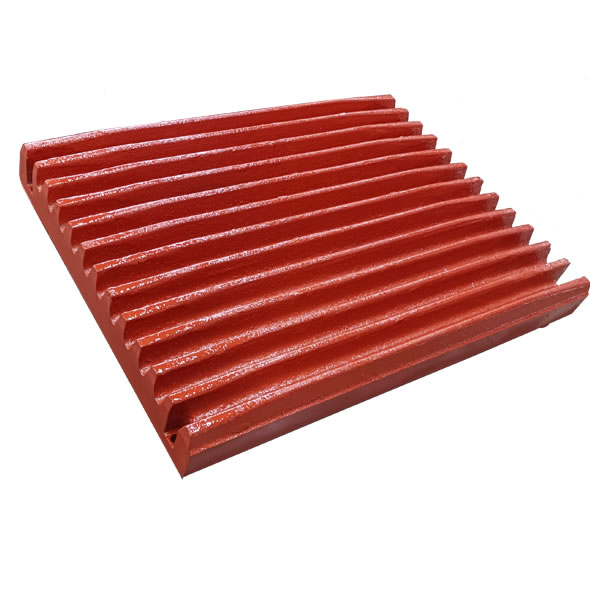
Jaw Plate
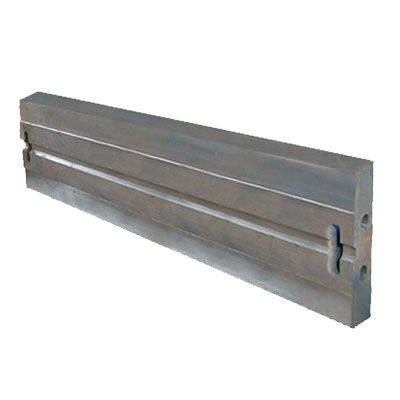
Blow Bar
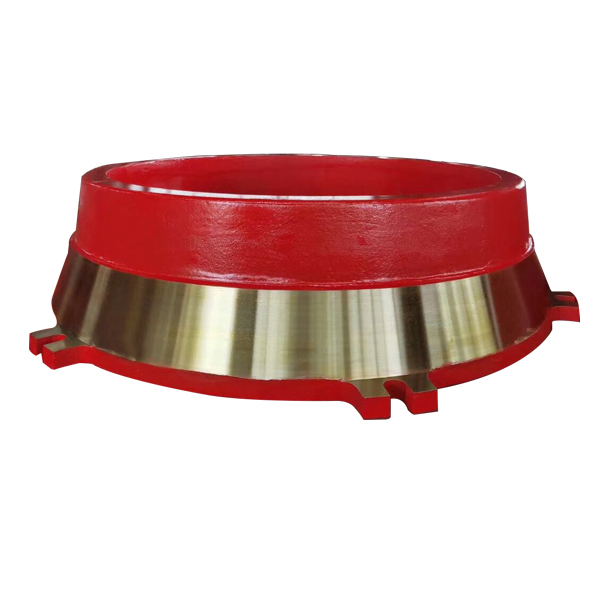
Mantle & Concave
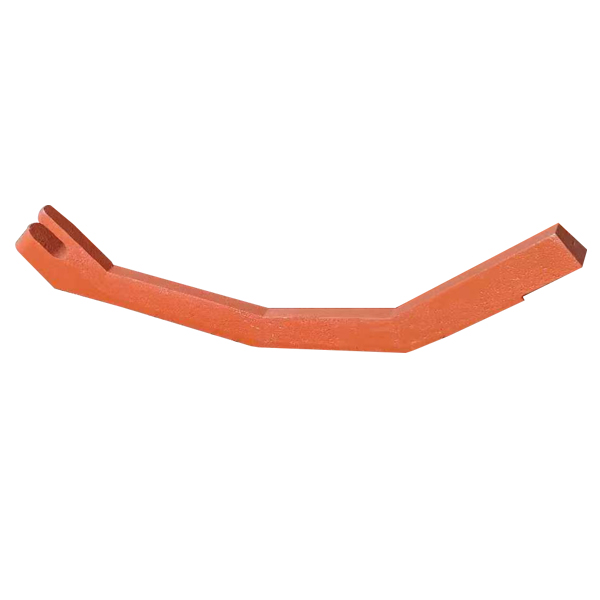
Grate Bar
Contact Us
Get a quote within 24 hours. Send us your inquiry today.

+86 178 4242 1247
Mon-Sat 8AM-10PM CST Scan to chat — English, Spanish, Chinese Send photos of worn parts for instant quote

+86 178 4242 1247
Scan to follow — factory updates and quotes Chat in Chinese or English