

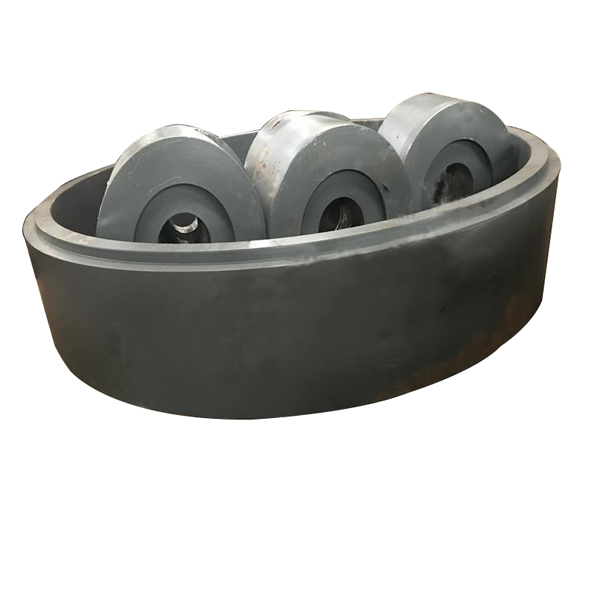
Raymond Mill Grinding Parts
Raymond Mill Grinding Rollers / Grinding Rings / Shovels — High Manganese Steel (Mn13Cr2 / Mn18Cr2) / High Chrome Cast Iron (Cr15 / Cr20 / Cr26) — For Raymond 3R / 4R / 5R / 6R Mills & YGM / MTM / ZTM Series
Raymond Mill Grinding Parts
Material Specifications & Selection Guide
| Grade | Material | Hardness | Carbide | Life Factor | Application |
|---|---|---|---|---|---|
| 65Mn | Spring Steel Forged | 48-55 HRC | — | 1.0x | Soft minerals, low abrasion |
| GCr15 | Bearing Steel | 58-62 HRC | — | 1.2-1.4x | Standard limestone, gypsum |
| Cr15 | Medium Cr White Iron | 56-60 HRC | 22-30% | 1.8-2.2x | Limestone, barite, dolomite |
| Cr20 | High Cr White Iron | 58-62 HRC | 25-33% | 2.0-2.5x | Hard minerals, silica |
| Cr26 | Ultra High Cr | 58-63 HRC | 28-38% | 2.5-3.0x | Abrasive ore, extreme wear |
| Grade | Material | Hardness | Carbide | Life Factor | Application |
|---|---|---|---|---|---|
| ZG270-500 | Carbon Cast Steel | 170-220 HB | — | 0.8x | Low cost, soft materials |
| Cr15 | Medium Cr White Iron | 56-60 HRC | 22-30% | 1.5-1.8x | Limestone, standard duty |
| Cr20 | High Cr White Iron | 58-62 HRC | 25-33% | 1.8-2.2x | Hard limestone, talc |
| Cr26 | Ultra High Cr | 58-63 HRC | 28-38% | 2.2-2.8x | Silica, abrasive minerals |
| Cr-Ni-Mo | Cr-Ni-Mo Alloy | 55-60 HRC | High | 2.0-2.5x | Corrosive materials |
| Raymond Model | Ring Dia. (mm) | Roller Qty | Roller Dia. (mm) | Rec. Roller | Rec. Ring |
|---|---|---|---|---|---|
| 3R1410 | 410 | 3 | 140 | GCr15 | Cr15 |
| 3R2115 | 530 | 3 | 150 | GCr15 | Cr15 |
| 3R2615 | 650 | 3 | 150 | Cr15 | Cr15 |
| 3R2715 | 780 | 3 | 150 | Cr15 | Cr20 |
| 4R3216 | 970 | 4 | 160 | Cr20 | Cr20 |
| 4R3220 | 1,000 | 4 | 200 | Cr20 | Cr26 |
| 5R4119 | 1,270 | 5 | 190 | Cr20 | Cr26 |
| 5R4121 | 1,300 | 5 | 210 | Cr26 | Cr26 |
| 6R4525 | 1,600 | 6 | 250 | Cr26 | Cr26 |
| 6R5127 | 1,700 | 6 | 270 | Cr26 | Cr-Ni-Mo |
Selection Quick Reference
- Soft minerals (limestone, gypsum, talc) standard duty: GCr15 grinding roller + Cr15 grinding ring — cost-effective for typical Raymond mill applications, 1.2-1.8x life factor, suitable for 3R1410 to 3R2715 models
- Medium hardness (limestone, barite, dolomite): Cr15 or Cr20 grinding roller + Cr20 grinding ring — balanced wear resistance and cost, recommended for 4R3216 and 4R3220 models processing standard industrial minerals
- Hard minerals (silica, bauxite, abrasive materials): Cr20 or Cr26 grinding roller + Cr26 grinding ring — maximum carbide content for severe abrasion, essential for 5R4119+ and 6R series large mills
- Corrosive or wet materials (chemical products, slag): Cr-Ni-Mo alloy grinding ring + Cr26 roller — Ni-Mo additions provide corrosion resistance, extends service life in aggressive environments
- Maximum wear protection (quartz, feldspar, hard ore): Cr26 for both roller and ring — ultra-high chrome content (28-38% carbide) provides 2.5-3.0x life factor for the most demanding Raymond mill applications
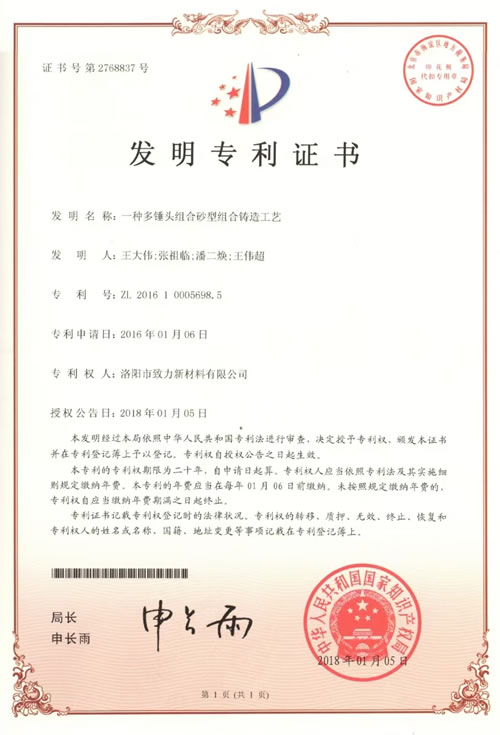
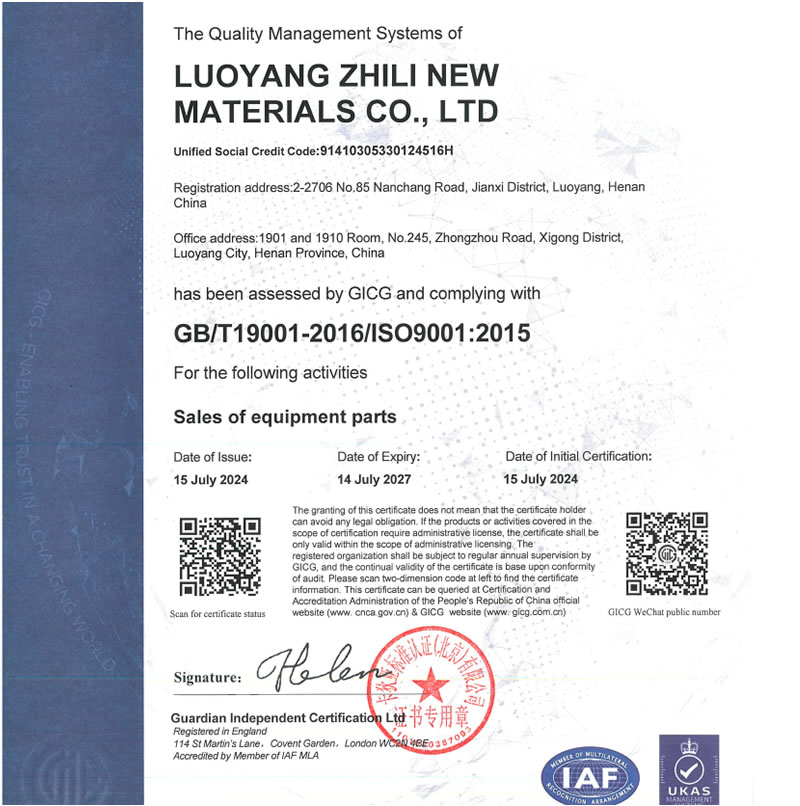
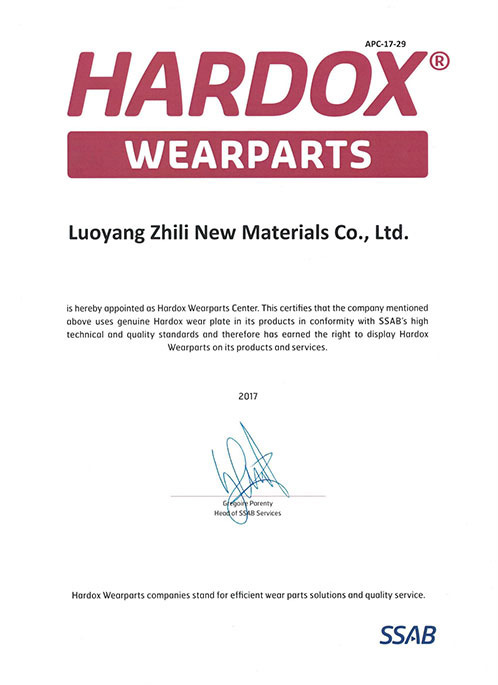
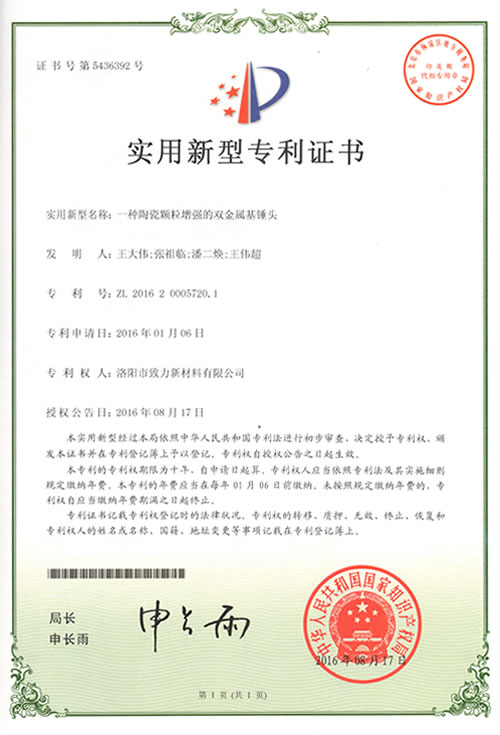
Certifications & Authorizations
Quality you can verify. Partners you can trust.
Custom OEM / ODM
From drawing to delivery — one-stop customization, no minimum order
Send Drawing
Upload your technical drawing (PDF, DWG, STEP, IGES) or share sample photos with dimensions
Engineering Review
Material recommendation, casting process design, DFM analysis — free quotation within 24 hours
Sampling & Test
Prototype production with full inspection: hardness test, spectrometer, dimensional check
Production & Ship
ISO 9001 certified. 15-25 days standard lead time. Global shipping with full documentation
Frequently Asked Questions
The grinding ring typically wears 20-30% faster than the rollers in Raymond mills. This is not a design defect — it’s a consequence of how the mill works:
Why the ring wears faster:
- Continuous contact zone: The ring is a 360-degree stationary track. Every point on the ring is subject to continuous abrasion as material is dragged through the grinding zone by the rotating rollers. The rollers, by contrast, only contact the grinding zone during the portion of their rotation that faces the ring — approximately 120-180 degrees of each revolution.
- Trapped material effect: As the rollers push material across the ring surface, fine particles become trapped at the roller-ring interface, creating a three-body abrasive wear situation. The ring, being stationary, accumulates more of this trapped abrasive layer.
- Heat concentration: Friction heat concentrates in the ring more than the rollers because the ring has no rotation to distribute thermal load. Higher temperature accelerates wear in both Mn steel (thermal softening) and high Cr iron (tempering of martensite matrix).
ZHILI recommendation: The optimized combo (Cr20 ring + Mn18Cr2 rollers) provides the best ROI for most applications. You upgrade the faster-wearing component (ring) by 1.5-1.8x life while keeping the slower-wearing component (rollers) at a lower cost. Switching to full Cr20 doubles the roller cost for only a marginal additional life gain. For ultra-abrasive applications (quartz, silica), full Cr26 on ring + Cr20 on rollers is justified.
Raymond mill grinding parts have a typical replacement interval of 800-2,000 operating hours depending on material hardness. Unlike crusher wear parts where profile loss affects product quality, Raymond mill grinding parts fail gradually through these stages:
Stage 1 — Early Wear (800-1,200 hrs):
- The grinding ring’s inner surface develops shallow grooves parallel to the roller rotation direction. The roller surface shows slight pitting. At this stage, finish product quality is still acceptable but mill output may start to decline by 5-10%.
- Action: Monitor motor current. A gradual increase of 5-10% above baseline at the same feed rate indicates increased grinding resistance from worn surfaces.
Stage 2 — Significant Wear (1,200-1,600 hrs):
- The grinding ring groove depth exceeds 3-5mm. The roller profile becomes visibly flattened (losing its original cylindrical shape). Product fineness decreases — you’ll see D97 increase by 50-100 microns. Vibration increases noticeably.
- Action: Plan replacement. Order replacement parts now to have them on-site before Stage 3.
Stage 3 — Failure Zone (>1,600 hrs):
- Ring groove depth exceeds 8-10mm. Roller bearings overload from unbalanced wear, leading to bearing failure (the most expensive consequence of delayed replacement). Product fineness fails specification. Mill vibration exceeds safe limits.
- Action: Immediate shutdown and replacement. A failed bearing from delayed roller replacement costs $2,000-5,000 in bearing parts + 2-3 days downtime — far more than the grinding part cost.
Three plant-floor indicators that don’t require mill shutdown:
- Motor current trending up at constant feed rate — the earliest signal, visible on the control room panel
- Finish product coarsening — D97 or residue on 325-mesh screen increasing by 5%+ at constant classifier settings
- Audible change — worn rollers produce a distinctive “growling” sound vs the smooth hum of properly fitted rollers
Despite the similar name, Raymond mill rollers and VRM grinding rollers are fundamentally different components with completely different operating principles:
Key differences:
- Size and scale: Raymond mill rollers are typically 210-510mm diameter, weighing 50-500 kg. VRM rollers are 1,800-3,000mm diameter, weighing 1,200-6,500 kg. VRM rollers are 5-15x larger.
- Grinding mechanism: Raymond mills use centrifugal force (rollers swing outward against the ring by rotation). VRM uses hydraulic pressure (rollers pressed down onto the table by hydraulic cylinders). VRM grinding forces are 10-50x higher.
- Wear mechanism: Raymond mill: pressure-abrasion from fine non-metallic mineral powder. VRM: rolling contact fatigue + high-stress abrasion + thermal stress from 250-450 C operating temperature. VRM wear is fundamentally more aggressive.
- Material selection: Raymond mills use Mn13Cr2/Mn18Cr2 or Cr15/Cr20 — these are adequate for non-metallic minerals. VRM rollers require Cr26/Cr27Mo2 with Mo content for hot hardness retention — these are over-specified and unnecessarily expensive for Raymond mill conditions.
Can you use VRM material in a Raymond mill? Technically yes, but it’s wasteful. Cr26 or Cr27Mo2 cost 1.5-2.5x more than Mn18Cr2 or Cr20 but provide minimal additional life in Raymond mill conditions because the wear mechanism (fine powder abrasion) doesn’t benefit from the Mo additions designed for high-temperature VRM service. The material must match the wear mechanism, not the component name.
ZHILI recommendation: For standard Raymond mills grinding limestone, calcite, or barite: Mn18Cr2 rollers + Cr20 ring. For hard minerals (quartz, silica): Cr20 rollers + Cr26 ring. Do not pay for VRM-grade Cr27Mo2 — that money is better spent on more frequent inspections and earlier replacement before bearing damage occurs.
Related Products
Jaw Plate
Blow Bar
Mantle & Concave
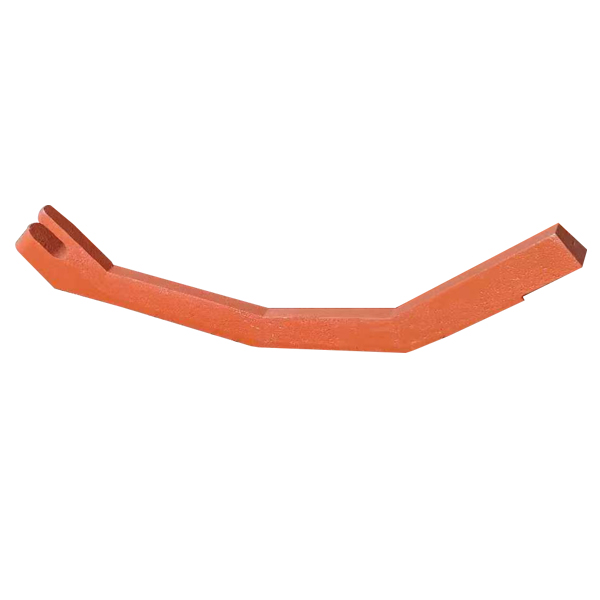
Grate Bar
Contact Us
Get a quote within 24 hours. Send us your inquiry today.

+86 199 8785 7268
Mon-Sat 8AM-10PM CST Scan to chat — English, Spanish, Chinese Send photos of worn parts for instant quote

+86 199 8785 7268
Scan to follow — factory updates and quotes Chat in Chinese or English