

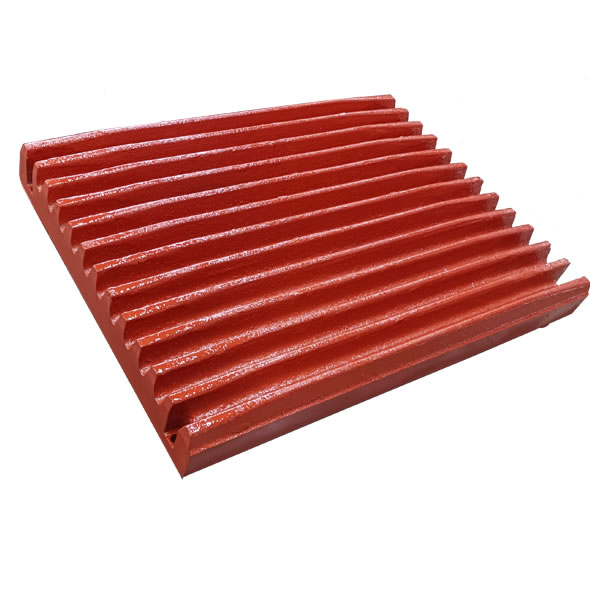
Crusher Jaw Plate
Jaw Crusher Fixed & Movable Jaw Plates — Mn13Cr2 / Mn18Cr2 / High Chromium Alloy / ZG-Mn13CrMo / Bi-Metallic Composite
Trusted by Holcim, CEMEX, E.Bayer (Germany) and 500+ global clients
Jaw Plates / Jaw Crusher Plates / Fixed & Movable Jaw Plates
Material Specifications & Selection Guide
| Grade | Material | Hardness (HB) | Work-Hardened (HB) | Life Factor | Application |
|---|---|---|---|---|---|
| Mn13 | Mn12-14% + C1.0-1.4% | 200-220 | 450-550 | 1.0x | Standard, soft to medium rock |
| Mn13Cr2 | Mn12-14% + Cr1.5-2.5% | 210-230 | 500-600 | 1.2-1.5x | Abrasive rock, extended life |
| Mn18Cr2 | Mn17-19% + Cr2.0-3.0% | 220-240 | 550-650 | 1.6-2.0x | Hard rock, heavy impact, primary |
| Mn22Cr2 | Mn20-22% + Cr2.0-3.0% | 230-250 | 600-700 | 2.0-2.5x | Extreme impact, PE900x1200+ |
| Mn13Mo | Mn12-14% + Mo0.5-1.0% | 210-230 | 480-580 | 1.3-1.5x | High-temperature, hot feed |
| Plate Type | Crusher Size | Length x Width (mm) | Thickness (mm) | Tooth Height (mm) | Tooth Pitch (mm) |
|---|---|---|---|---|---|
| Fixed / Movable | PE250x400 | 400×250 | 40-60 | 15-25 | 30-50 |
| Fixed / Movable | PE400x600 | 600×400 | 50-80 | 20-35 | 40-70 |
| Fixed / Movable | PE600x900 | 900×600 | 70-110 | 30-50 | 60-90 |
| Fixed / Movable | PE750x1060 | 1060×750 | 90-130 | 40-60 | 70-110 |
| Fixed / Movable | PE900x1200 | 1200×900 | 110-160 | 50-80 | 90-140 |
| Fixed / Movable | PE1200x1500 | 1500×1200 | 140-200 | 70-100 | 120-180 |
| Crusher Model | Feed Opening (mm) | Fixed Plate Weight (kg) | Movable Plate Weight (kg) | Rec. Material | OEM Ref. |
|---|---|---|---|---|---|
| PE250x400 / C63 | 250×400 | 60-90 | 50-80 | Mn13 | Metso C63 / Sandvik CJ408 |
| PE400x600 / C80 | 400×600 | 150-220 | 130-190 | Mn13 / Mn13Cr2 | Metso C80 / Sandvik CJ409 |
| PE500x750 / C96 | 500×750 | 280-400 | 240-350 | Mn13Cr2 | Metso C96 / Sandvik CJ411 |
| PE600x900 / C100 | 600×900 | 480-700 | 420-600 | Mn13Cr2 / Mn18Cr2 | Metso C100 / Sandvik CJ412 |
| PE750x1060 / C110 | 750×1060 | 900-1300 | 800-1100 | Mn18Cr2 | Metso C110 / Sandvik CJ613 |
| PE900x1200 / C125 | 900×1200 | 1500-2200 | 1300-1900 | Mn18Cr2 / Mn22Cr2 | Metso C125 / Sandvik CJ615 |
| PE1200x1500 / C150 | 1200×1500 | 2800-4000 | 2400-3500 | Mn22Cr2 | Metso C150 / Sandvik CJ815 |
Selection Quick Reference
- Soft-medium rock (limestone, dolomite, <150 MPa): Mn13 standard jaw plates with standard tooth profile (15-25 mm tooth height). Work-hardened surface reaches 450-550 HB under the cyclic compressive crushing action. Fixed plate wears approximately 1.2x the movable plate — expect 4-8 months life at 200-400 t/h
- Abrasive rock (granite, basalt, 150-200 MPa): Mn13Cr2 with chromium-enhanced work hardening — the Cr addition forms finer deformation twins, accelerating surface hardening and improving wear resistance 1.2-1.5x over Mn13. Use sharper tooth profile (higher tooth height-to-pitch ratio) for better grip on hard, smooth rock
- Hard rock, heavy impact (iron ore, quartzite, >200 MPa): Mn18Cr2 or Mn22Cr2 — higher manganese extends work-hardened layer depth from 5-10 mm (Mn13) to 10-20 mm (Mn18Cr2) and 15-25 mm (Mn22Cr2). Deeper hardening means the plate maintains its wear-resistant surface significantly longer. Fixed and movable plates develop asymmetric wear — the movable plate wears 1.3-1.5x faster and should be upgraded one grade above the fixed plate
- Tooth profile selection (critical for product size): Coarse tooth (high pitch, deep depth) for primary crushing of large feed (200-1,500 mm) — better grip, higher throughput. Medium tooth for secondary crushing. Fine tooth for tertiary or high-ratio reduction. Smooth profile plates (no teeth) available for specific applications requiring cubical product shape. Never use smooth plates for feed >100 mm — material slips rather than grips, reducing throughput 30-50%
- Custom OEM service: Reverse-engineer jaw plates from your existing worn parts or OEM drawings. ZHILI reproduces exact tooth profile, mounting bolt pattern, and plate curvature for 1:1 OEM fit. Asymmetric tooth profiles available for fixed vs. movable plates to optimise grip and wear distribution. All plates 100% dimensional inspection before shipment. Delivery 15-20 days for standard grades
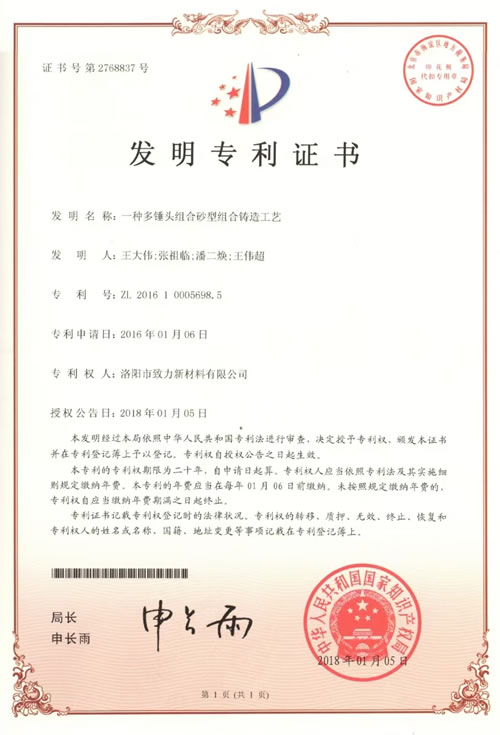
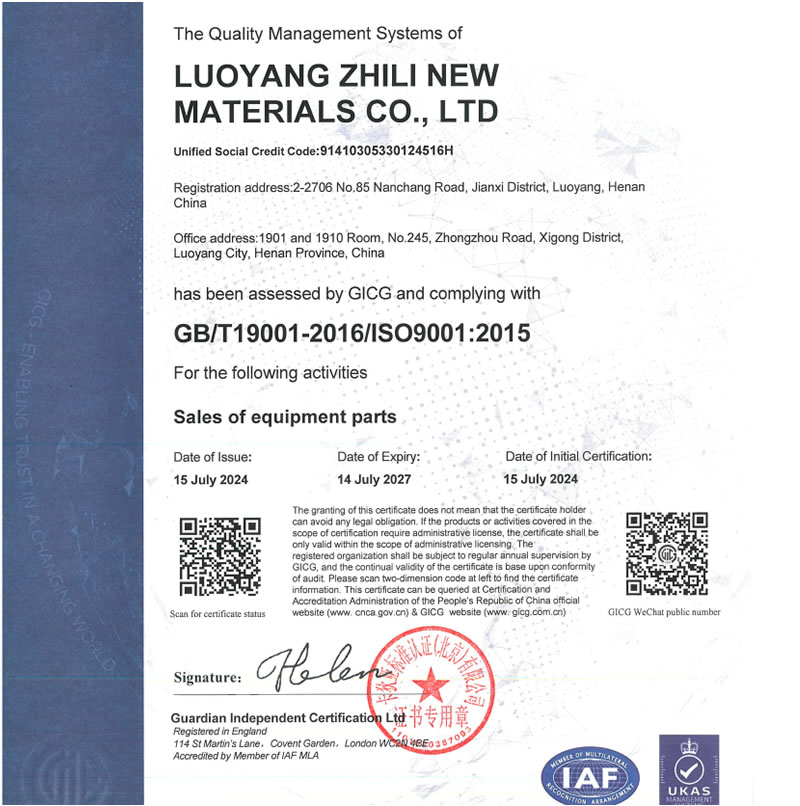
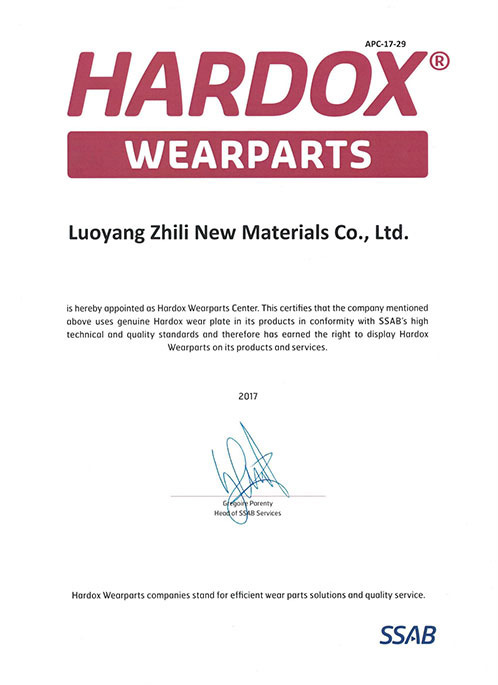
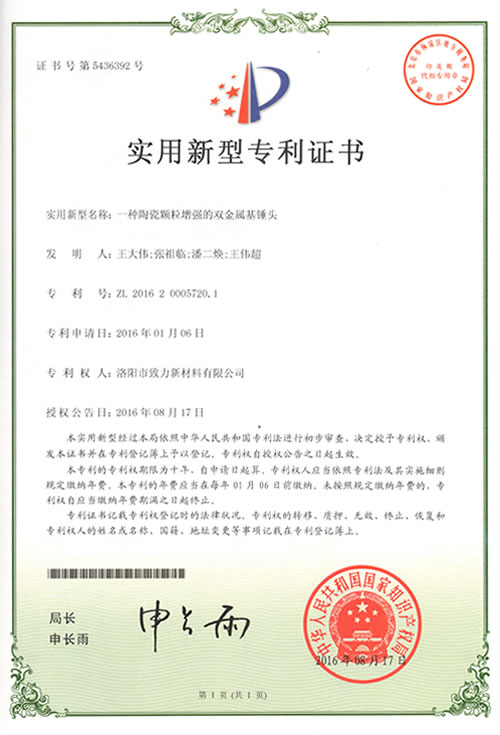
Certifications & Authorizations
Quality you can verify. Partners you can trust.
Custom OEM / ODM
From drawing to delivery — one-stop customization, no minimum order
Send Drawing
Upload your technical drawing (PDF, DWG, STEP, IGES) or share sample photos with dimensions
Engineering Review
Material recommendation, casting process design, DFM analysis — free quotation within 24 hours
Sampling & Test
Prototype production with full inspection: hardness test, spectrometer, dimensional check
Production & Ship
ISO 9001 certified. 15-25 days standard lead time. Global shipping with full documentation
Compatible Brands & Models
Aftermarket wear parts engineered for 200+ crusher models across all major OEM brands
C Series · NP Series · HP Series · GP Series · MP Series · Barmac
CJ Series · CI Series · CH Series · CS Series · JM Series · QJ Series
EV Series · RAPTOR · Excel · Fuller-Traylor · KREBS
TITAN Series · EB Series · Kubria · Polysius
APK Series · APSE Series · HPI Series · HPC Series
Powerscreen · Cedarapids · Canica · Pegson · Jaques
MC Series · MR Series · MS Series · MOBICAT · MOBIREX
SBM HSI/VSI · Trio · Telsmith · Nordberg · KPI-JCI · Gator
| Brand | Crusher Type | Key Models | Compatible Wear Parts |
|---|---|---|---|
| Metso | Jaw / Impact / Cone / VSI | C80-C200, NP1110-NP1520, HP200-HP800, GP100-GP550, Barmac B6150-B9100 | Jaw Plate, Blow Bar, Cone Liner, Rotor Tip, Hammer |
| Sandvik | Jaw / Impact / Cone | CJ408-CJ815, CI711-CI722, CH420-CH890, CS420-CS660, QJ241-QJ341 | Jaw Plate, Blow Bar, Cone Liner, Hammer |
| FLSmidth | Hammer / Cone / Gyratory | EV 200×300, RAPTOR 250-1100, Excel XL Series, Fuller 42-65 | Hammer, Cone Liner, Mantle & Concave, Grate Plate |
| ThyssenKrupp | Gyratory / Jaw / Cone | TITAN 70D75, EB 12-10N, Kubria F/M 90-210 | Mantle, Concave, Jaw Plate, Cone Liner |
| Hazemag | Impact / Hammer | APK 40-60, APSE 1313-1620, HPI 2030, HPC 2022 | Blow Bar, Hammer, Impact Plate, Liner |
| Terex | Jaw / Impact / Cone / VSI | Powerscreen XA400-XA750, Cedarapids JS3042-JS5460, Canica 2000-3000 | Jaw Plate, Blow Bar, Cone Liner, Rotor Tip |
| Kleemann | Jaw / Impact / Cone | MC 100-125, MR 110-170, MS 15-20, MOBICAT/MOBIREX Series | Jaw Plate, Blow Bar, Cone Liner, Hammer |
| Others | Various | Trio CT/TC, Telsmith 44SBS-68SBS, SBM RCI/VSI, KPI-JCI, Gator, Nordberg | Custom to drawing — contact for compatibility |
Over 200 crusher models covered with 2,000+ existing patterns. If your brand or model is not listed, send us the specifications — new pattern development available at no extra cost for standard orders.
CHECK COMPATIBILITY & GET QUOTEFrequently Asked Questions
Quick answers to common questions about our jaw crusher plates
Jaw plate selection involves two independent decisions: material grade for wear life and tooth profile for crushing efficiency. Getting either wrong reduces throughput and increases cost per ton:
- Mn13 (standard, 50% of applications): The benchmark for limestone, dolomite, and soft-medium rock where compressive strength is below 150 MPa. Under the cyclic compressive crushing action, the jaw plate surface work-hardens from 200 HB to 450-550 HB — exactly where the crushing forces are highest. The work-hardened layer self-renews as the surface wears. Tooth life of 4-8 months in these conditions is typical. Mn13 (Hadfield steel) has been the dominant jaw plate material for over 100 years because its unique combination of high toughness + self-hardening cannot be matched by any other material at this cost point.
- Mn13Cr2 (abrasion-enhanced, 30% of applications): The chromium addition (1.5-2.5%) to Mn13 accelerates the work-hardening kinetics — finer deformation twins form more rapidly under impact, producing a harder surface (500-600 HB) that develops in fewer crushing cycles. This is critical for abrasive rocks (granite, basalt, quartzite) where the surface must harden quickly before the softer initial microstructure is worn away. Mn13Cr2 extends life 1.2-1.5x over Mn13 in abrasive conditions. Also use when feed contains sharp, angular particles that cause gouging wear in addition to compressive crushing.
- Mn18Cr2 / Mn22Cr2 (heavy duty, 20% of applications): Increasing manganese from 13% to 18-22% dramatically deepens the work-hardened layer — from 5-10 mm (Mn13) to 10-20 mm (Mn18Cr2) and 15-25 mm (Mn22Cr2). This is essential for primary jaw crushers (PE750x1060+) processing hard rock at 500-1,500 t/h where jaw plate thickness is 90-200 mm. A deeper hardened layer means the plate can wear 2-3x more material before the softer core is exposed and wear accelerates. Rule: for plates >100 mm thick, use Mn18Cr2; for plates >150 mm thick, use Mn22Cr2. The extra manganese pays for itself through extended service intervals.
- Tooth profile selection (equally important): Coarse tooth (high pitch 90-180 mm, deep depth 50-100 mm) — for primary crushing of large feed (300-1,500 mm), deep teeth grip large rocks and prevent them riding up the chamber. Medium tooth (pitch 60-90 mm) — for secondary crushing. Fine/sharp tooth — for high-ratio reduction in smaller crushers, sharp teeth penetrate and fracture rock more efficiently. Critical: never use smooth plates for feed >100 mm — material slips on the plate surface rather than being gripped, reducing throughput 30-50% and increasing wear by concentrating load on a smaller contact area. Smooth plates are only for tertiary crushing of already-small feed (<80 mm) where product shape is the priority.
Quick selection: Step 1 — measure feed rock compressive strength (MPa). <150 MPa → Mn13, 150-200 MPa → Mn13Cr2, >200 MPa → Mn18Cr2. Step 2 — measure plate thickness. <80 mm → standard grade, 80-150 mm → upgrade one grade, >150 mm → Mn22Cr2. Step 3 — select tooth profile: feed >300 mm → coarse tooth, 100-300 mm → medium, <100 mm → fine or smooth. Step 4 — fixed plate wears 1.2x slower than movable plate; upgrade the movable plate one grade above the fixed plate to equalise wear and enable simultaneous replacement.
Uneven jaw plate wear is the #1 cause of premature plate replacement — often 40% of the plate volume is unworn when the plate is replaced because the worn zone controls product size:
- Bottom-third concentration wear (universal jaw plate pattern): The lower 20-30% of the jaw plate — the discharge zone — wears 3-5x faster than the upper zone. This is because: (a) the crushing force and material pressure increase exponentially toward the discharge (the CSS is the narrowest point); (b) crushed material slides down the plate surface at maximum velocity in this zone, creating sliding abrasion on top of compressive impact; (c) the material in this zone is already sized close to the CSS, so it rubs rather than breaks. Result: the tooth profile erodes from the bottom upward, effectively shortening the plate’s working length. When tooth height at the bottom reaches 20-25% of original, the plate must be replaced — even if the upper 70% shows minimal wear. Continuing to run with worn bottom teeth increases product size (effective CSS widens) and reduces throughput 15-25%.
- Movable vs. fixed plate wear asymmetry: The movable plate wears 1.3-1.5x faster than the fixed plate because it experiences both compressive and sliding wear — the moving jaw’s eccentric motion creates a downward sliding component as it closes. The fixed plate experiences primarily compressive wear. This asymmetry means the plates reach their wear limits at different times, forcing two separate crusher openings if replaced sequentially. Solution: (a) use a higher-grade material on the movable plate (Mn18Cr2 movable + Mn13Cr2 fixed) to equalise wear rates; or (b) design the movable plate 15-25% thicker than the fixed plate so both reach the wear limit simultaneously. ZHILI can supply asymmetric plate sets engineered for simultaneous replacement.
- Jaw plate reversal (doubles life, zero cost): Most jaw plates are designed with 180-degree symmetry — flip the plate top-to-bottom so the unworn upper zone becomes the new discharge zone. This effectively doubles plate life because both ends wear equally. Reverse plates when bottom tooth height reaches 30-40% of original — do not wait until the bottom is completely worn flat, as the plate may have developed micro-cracks that propagate after reversal. After reversal, the CSS must be re-set because the plate thickness at the new discharge zone (formerly the feed zone) is greater than the worn discharge zone. Expect a 2-5 mm CSS adjustment after reversal. Record each reversal in the plate log — plates are typically reversed once or twice before final replacement.
- Replacement decision — use a profile gauge: A simple profile gauge (a piece of sheet metal cut to the original tooth profile) is the most reliable wear measurement tool. Place the gauge against the plate at the discharge zone — the gap between the gauge and the worn tooth surface is the absolute wear depth. Replace when this gap exceeds 75-80% of the original tooth height. Why not use remaining thickness? Because tooth height controls both grip and product size, while remaining plate thickness is primarily structural. A plate can have 60% thickness remaining but teeth worn to 10% — it will grip poorly but not structurally fail. Replace based on tooth wear, not thickness.
The $0 reversal strategy: A jaw plate costing $3,000-15,000 that is reversible effectively costs half per operating hour. Schedule reversal into the planned maintenance calendar — every 400-600 hours or when bottom tooth height reaches 30-40% of original. A 2-hour reversal procedure (loosen bolts, flip plate, re-tighten, re-set CSS) doubles plate life and halves the plate cost per ton. Over a set of two plates, this simple procedure saves $3,000-15,000 in plate cost alone, plus avoided downtime for a full plate change.
Jaw plate installation is critical to crusher safety and plate life. A loose jaw plate rocks under load, creating bolt stress 5-10x the design value and cracking the plate around bolt holes within hours:
- Frame seat preparation (step 1 — critical base): Clean the crusher frame mounting surface to bare metal. Remove all old backing material, rust, scale, and debris. Any material trapped between the plate and frame prevents full seating — even a 1 mm particle creates a fulcrum that concentrates bolt stress and cracks the plate around the bolt hole. Check the frame surface for wear — over years of service, the frame surface where the plate seats can develop wear grooves or erosion. Any depression >2 mm deep must be built up with weld and ground flat. A worn frame surface guarantees the new plate cannot seat properly regardless of bolt torque.
- Backing application (step 2 — non-negotiable for large plates): Apply a continuous, even layer of crusher backing compound (epoxy resin or zinc-based filler) to the clean frame surface before placing the plate. The backing serves four critical functions: (a) fills micro-gaps between the plate and frame, distributing crushing loads evenly — without backing, only 3-5 high points of the plate contact the frame, creating 10-20x stress concentration at those points; (b) damps impact shock, protecting the frame; (c) prevents fine material packing behind the plate, which can bow the plate outward and crack it; (d) provides a release layer for future plate removal. For plates >80 mm thick, backing is mandatory; for thinner plates, it is strongly recommended. Use crusher-specific backing rated for 100 MPa+ compressive strength.
- Bolt tightening sequence (step 3 — precision sequence): (a) Start all bolts finger-tight only. (b) Tighten the centre bolts first (top-to-bottom or bottom-to-top, depending on crusher design) to 50% torque, then the edge bolts. This centre-first sequence ensures the plate seats flat against the frame from the centre outward. (c) Complete a second pass at 100% torque using the same sequence. (d) Mark each bolt head with a paint stripe crossing from the bolt head onto the plate — this provides instant visual inspection of loosening (broken paint stripe = loosened bolt). (e) For wedge-type jaw plates (common on larger crushers), tighten the wedges after the bolts — the wedge clamping force adds to the bolt clamping force for a dual-lock system.
- Post-installation checks (step 4 — do not skip): (a) After 8 operating hours, stop and re-torque all bolts to specification. New plates bed into the frame surface during initial crushing, relaxing bolt preload by 15-25%. (b) After 50 hours, re-torque again — any further relaxation indicates an installation problem (debris under plate, uneven frame surface, or backing compound void). (c) Inspect the plate edge-to-frame gap with a feeler gauge — any gap >1 mm means the plate is not fully seated and must be re-installed. (d) Check the plate surface for hairline cracks radiating from bolt holes — these indicate the plate is rocking under load and must be re-installed with new backing compound. A cracked plate around a bolt hole will fail completely if not corrected.
ZHILI installation kit: Every ZHILI jaw plate set includes pre-measured backing compound (correct volume for your crusher model), bolt torque specification card, paint marking pen, and a step-by-step installation checklist. Matched fixed + movable plate sets are supplied with certified weight documentation and tooth profile templates for wear measurement. This eliminates the two most common installation errors — incorrect backing application and under-torqued bolts — and reduces installation time from 4-6 hours to 2-3 hours.
Related Products
Jaw Plate
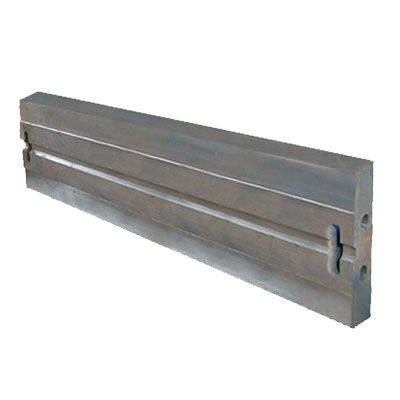
Blow Bar
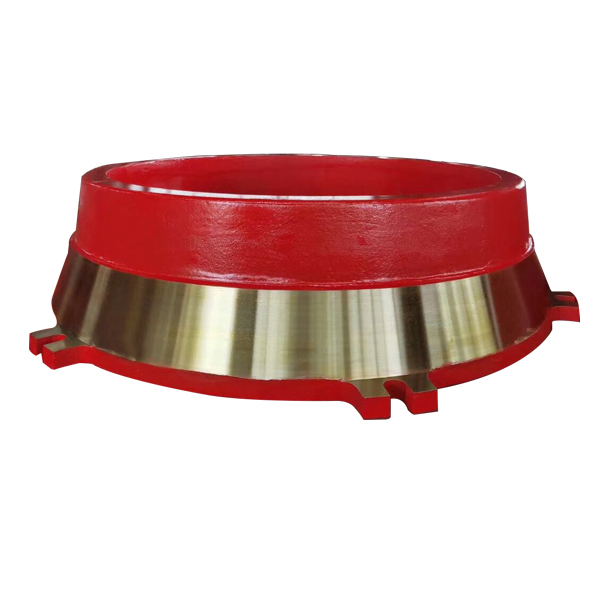
Mantle & Concave
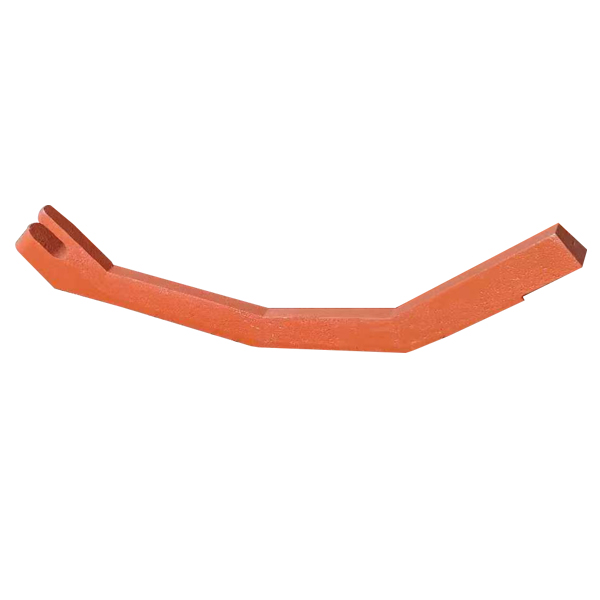
Grate Bar
Contact Us
Get a quote within 24 hours. Send us your inquiry today.

+86 199 8785 7268
Mon-Sat 8AM-10PM CST Scan to chat — English, Spanish, Chinese Send photos of worn parts for instant quote

+86 199 8785 7268
Scan to follow — factory updates and quotes Chat in Chinese or English