

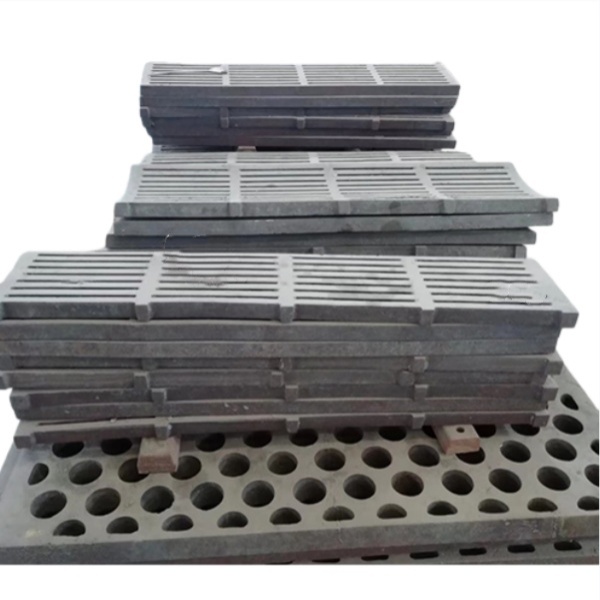
Crusher Grate Plate
Hammer Crusher Discharge Grate / Screen Plate / Grate Bar — Mn13Cr2 / Mn18Cr2 / High Chrome Alloy — Round Hole / Square Hole / Slotted Design
Crusher Grate Plate / Sieve Plate / Screen Plate
Material Specifications & Selection Guide
| Grade | Material | Hardness | Impact | Life Factor | Application |
|---|---|---|---|---|---|
| Mn13 | Mn12-14% + C1.0-1.4% | 200-220 HB / 450-550 HB WH | Excellent | 1.0x | Soft rock, limestone, low abrasion |
| Mn13Cr2 | Mn12-14% + Cr1.5-2.5% | 210-230 HB / 500-600 HB WH | Excellent | 1.2-1.5x | Standard duty, medium-hard ore |
| Mn18Cr2 | Mn17-19% + Cr2.0-3.0% | 220-240 HB / 550-650 HB WH | Superior | 1.6-2.0x | Hard rock, high impact, iron ore |
| Cr20 | Cr18-22% + C2.4-3.2% | 58-62 HRC | Low | 2.5-3.0x | Cement clinker, high abrasion |
| Cr26 | Cr23-28% + C2.3-3.0% | 58-63 HRC | Low | 3.0-3.5x | Slag, silica, max. abrasion resistance |
| Grate Type | Slot/Hole Size (mm) | Open Area | Plate Thickness (mm) | Arc Radius (mm) | Product Size |
|---|---|---|---|---|---|
| Fine Slotted | 8-15 x 30-80 | 20-30% | 25-40 | 400-600 | 0-8 mm |
| Medium Slotted | 15-25 x 40-100 | 25-35% | 30-50 | 500-800 | 8-20 mm |
| Coarse Slotted | 25-50 x 60-120 | 30-40% | 40-60 | 600-1000 | 20-50 mm |
| Round Hole | phi8-phi30 | 15-25% | 30-50 | 500-800 | Precise sizing |
| Square Hole | 10×10 – 40×40 | 20-30% | 30-50 | 500-900 | Cubical product |
| Crusher Model | Rotor Dia. x Width | Grate Plate (mm) | Slot Type | Rec. Material | OEM Ref. |
|---|---|---|---|---|---|
| PC400x300 | 400×300 | 300×200 | Slotted | Mn13 | SBM / Liming |
| PC600x400 | 600×400 | 400×280 | Slotted | Mn13 / Mn13Cr2 | SBM / Sanyyo |
| PC800x600 | 800×600 | 500×350 | Slotted / Round | Mn13Cr2 | SBM PC800 |
| PCK1000x800 | 1000×800 | 600×400 | Slotted / Square | Mn13Cr2 / Mn18Cr2 | FLSmidth EV |
| PCH1010 | 1000×1000 | 700×450 | Slotted / Round | Mn18Cr2 | Liming PCH |
| PCK1200x1200 | 1200×1200 | 800×500 | Slotted / Square | Mn18Cr2 / Cr20 | Hazemag / ThyssenKrupp |
| PCH1616 | 1600×1600 | 1000×600 | Slotted | Mn18Cr2 / Cr26 | FLSmidth / Sinoma |
Selection Quick Reference
- Fine sizing (0-8 mm, limestone for cement): Fine-slotted Mn13Cr2 grate plates with 8-15 mm slot width and 20-30% open area. Narrow slots produce consistent ball mill feed with minimal oversize. Plate thickness 25-40 mm balances wear life with open area
- Medium sizing (8-20 mm, aggregate production): Medium-slotted Mn13Cr2/Mn18Cr2 plates with 15-25 mm slot width and 25-35% open area. This is the most common configuration for road base and concrete aggregate. Open area >30% improves throughput but may allow elongated particles
- Coarse sizing (20-50 mm, primary crusher discharge): Coarse-slotted Mn18Cr2 plates with 25-50 mm slot width and 30-40% open area. High manganese with Cr addition resists hammer impact while maintaining slot edge sharpness. Plate thickness 40-60 mm for extended service
- Precise product sizing (round hole): Round-hole Cr20/Cr26 high chrome plates deliver consistent product size for applications requiring minimal variability. Round holes 8-30 mm produce cubical particles; rectangular slots may produce elongated/flaky particles in certain materials
- Custom OEM service: Reverse-engineer from your existing grate plates or OEM drawings. ZHILI reproduces exact slot/hole pattern, open area ratio, and arc radius to match original crusher performance. Plate thickness and material grade upgraded per your wear data. Delivery 15-20 days
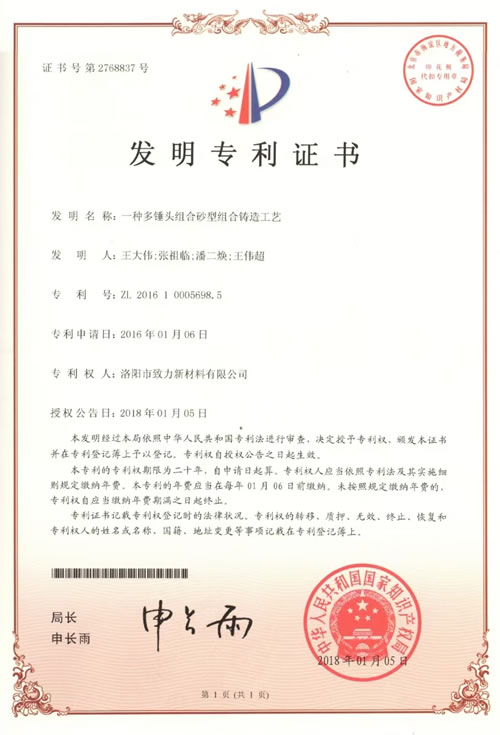
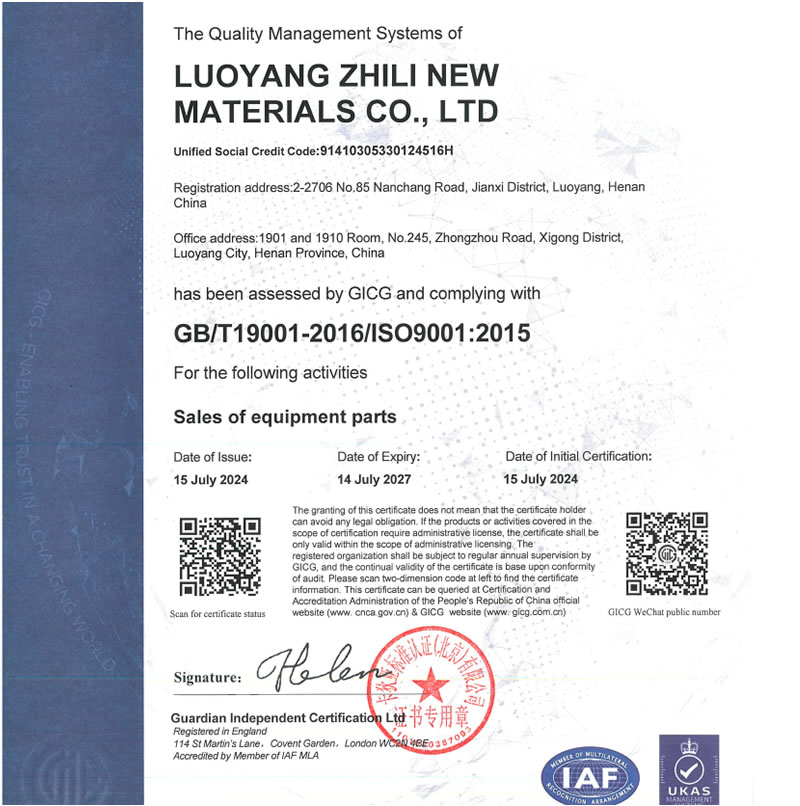
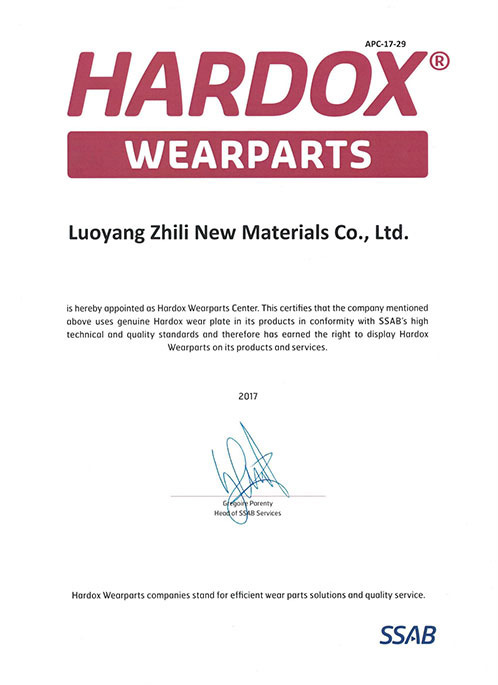
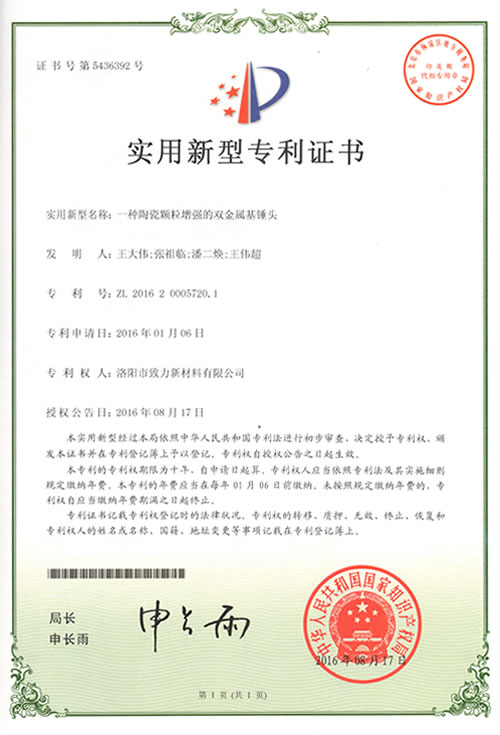
Certifications & Authorizations
Quality you can verify. Partners you can trust.
Custom OEM / ODM
From drawing to delivery — one-stop customization, no minimum order
Send Drawing
Upload your technical drawing (PDF, DWG, STEP, IGES) or share sample photos with dimensions
Engineering Review
Material recommendation, casting process design, DFM analysis — free quotation within 24 hours
Sampling & Test
Prototype production with full inspection: hardness test, spectrometer, dimensional check
Production & Ship
ISO 9001 certified. 15-25 days standard lead time. Global shipping with full documentation
Frequently Asked Questions
Quick answers to common questions about our crusher grate plates & sieve plates
Grate plates are the final product size control element in a hammer crusher. Every particle leaving the crusher must pass through the grate — slot design determines both product size and crusher throughput:
- Slotted grate plates (most common, 80% of applications): Elongated slots oriented parallel to the rotor axis allow particles to pass through when their smallest dimension fits the slot width. This produces a slightly flaky product but offers the highest throughput for a given open area. Slot width = 1.2-1.5x target P80 — for a P80 of 15 mm, use 18-22 mm slots. Oversize fraction (>target) should be <10% — if higher, slots are too wide or bars are worn.
- Round hole grate plates (precise sizing): When product shape is critical (concrete aggregate, road base), round holes produce cubical particles because material must rotate to pass through. Open area is 15-25% (lower than slotted) because more plate material is needed between holes for strength. Rule: hole diameter = 1.0-1.2x target maximum particle size. Expect 20-30% lower throughput vs slotted plates with the same open area due to reduced probability of particle-hole alignment.
- Square hole grate plates (compromise solution): Better throughput than round holes with better shape control than slots. Open area 20-30%. Produces more cubical product than slots because particles must align in two dimensions to pass. Good choice for secondary crushing where product shape matters but throughput cannot be sacrificed.
- Open area trade-off: Higher open area (35-40%) = higher throughput but shorter plate life because there is less plate material to wear. Lower open area (20-25%) = longer plate life but risk of packing — material accumulates on the grate when open area is too small relative to feed rate. The sweet spot is 25-35% for most applications. Signs of packing: motor amperage rises 15-20% above normal, throughput drops, and you hear a “choked” sound. Increase open area by 5% or reduce feed rate.
Product size rule: Slot width = P80 x 1.2-1.5. Round hole dia. = Pmax x 1.0-1.2. Always verify with a calibration run: collect 50 kg of crusher discharge, sieve it on a laboratory screen matching your target size, and adjust grate opening if oversize exceeds 10% or undersize exceeds 40%.
Grate plates experience a unique wear combination: hammer impact from above + abrasive sliding from below. Material selection must handle both mechanisms simultaneously:
- High manganese (Mn13, Mn13Cr2, Mn18Cr2) — for impact-dominated crushing: Grate plates in hammer crushers receive direct impact from hammers striking oversized material above the grate. This impact work-hardens the Mn steel surface from 200 HB to 500-650 HB — exactly where it is needed. Mn13 (standard) for limestone and soft rock; Mn13Cr2 (chromium-enhanced) extends life 1.2-1.5x through improved work-hardening response; Mn18Cr2 for iron ore and hard rock where impact energy is highest. The work-hardened layer is self-renewing — as the surface wears, new material underneath also work-hardens. This makes Mn steel the most cost-effective for most crusher grate applications.
- High chrome (Cr20, Cr26) — for abrasion-dominated crushing: In cement clinker grinding and slag crushing, material arriving at the grate is already fine (mostly <25 mm) and impact is low. Wear comes from fine abrasive particles sliding across the grate surface. Cr20/Cr26 is through-hardened to 58-63 HRC and resists this sliding abrasion 2.5-3.5x better than Mn steel. However, high chrome is brittle — a single large rock fragment (>50 mm) driven into the grate by a hammer can crack a chrome plate. Only use chrome grates when <5% of feed >50 mm arrives at the grate intact.
- The cost equation: Cr20 grate plates cost 30-50% more than Mn13Cr2. The break-even point is approximately 12 months of Mn steel life. If your Mn grate plates last >12 months, chrome does not pay back within a typical 2-year budget cycle. If Mn plates last <6 months (high-silica limestone, clinker, slag), chrome pays back in 8-12 months through reduced replacement frequency and downtime savings.
- Mixed configuration: In large crushers (PCK1000+), install Cr20 plates in the centre zone where material is finest and impact lowest, and Mn18Cr2 plates at the edges where large fragments may still impact. This hybrid approach captures chrome’s wear advantage where it is safe and Mn’s impact toughness where it is needed.
Field test recommendation: Replace one half of the grate assembly with the candidate material and the other half with your current material. After 1,000 hours, measure wear depth at 5 positions on each plate. If the candidate material shows >40% less wear, the upgrade pays for itself. ZHILI can supply matched pairs (Mn + Cr) for side-by-side testing — just specify your crusher model.
Grate plate maintenance is the most frequent downtime event on hammer crushers. A systematic approach turns a 6-hour plate change into a 90-minute procedure:
- Grate plate rotation (doubles life, zero cost): Most slotted grate plates have symmetrical bolt-hole patterns allowing 180-degree rotation — swap the leading edge to the trailing edge. The leading edge (where hammers sweep material onto the grate) wears 2-3x faster than the trailing edge. Rotating distributes this wear evenly. Do this every 500-800 operating hours. A $0 rotation effectively doubles plate service life. Mark the leading edge with paint before removal to track rotation history.
- End-to-end swapping: In crushers with multiple grate sections (typically 3-5 plates across the width), the centre plates wear 1.3-1.5x faster than edge plates. Swap centre plates with edge plates during rotation to equalise wear across the set. This allows replacing the entire grate set simultaneously rather than piecemeal — reducing total number of crusher openings by 30-40%.
- Pre-assembled cassette method (fastest replacement): Bench-assemble a complete grate plate set with bolts, spacers, and shims in the workshop before the shutdown. Remove the entire worn cassette in one piece and install the pre-assembled replacement. This reduces on-site work from 4-6 hours to 20-30 minutes per cassette. Critical: pre-set all bolt torques on the bench — the correct sequence is centre-to-ends in a star pattern to prevent plate warping and uneven gaps.
- Replacement timing: Replace grate plates when slot width wears to 120% of original specification (e.g., a 20 mm slot becomes 24 mm). Beyond this point, oversize material bypasses the grate at an accelerating rate. Measure slot width with a calibrated feeler gauge at 5 positions across each plate. Plot wear rate (mm/1,000 tons) — the curve steepens after slots reach 110% of original because the worn edges present a wider target to abrasive material. Replace before the curve steepens.
ZHILI cassette replacement system: For PC800-PCK1200 crushers, we supply complete pre-assembled grate cassettes — plates mounted on a sub-frame with all bolts torqued to specification. The cassette drops into the crusher housing and bolts to the existing mounting points. Change time: 20-30 minutes. We also maintain a shadow-stock program: we hold one cassette in our warehouse, ship it when your current set reaches 80% wear, and you return the worn cassette for rebuild credit. This eliminates weeks of lead-time uncertainty.
Related Products
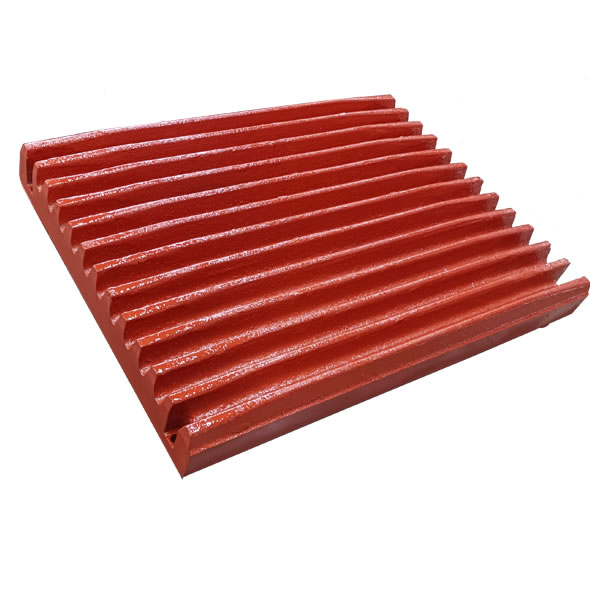
Jaw Plate
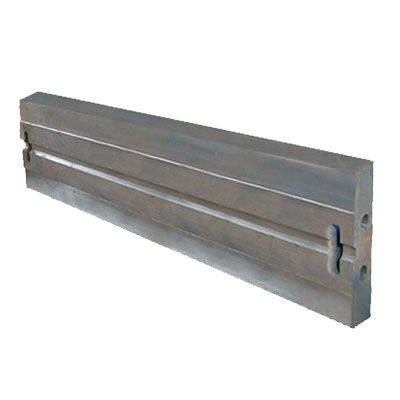
Blow Bar
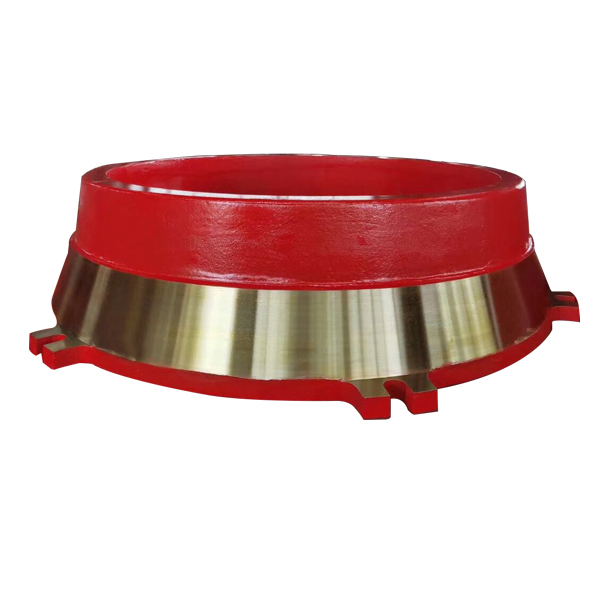
Mantle & Concave
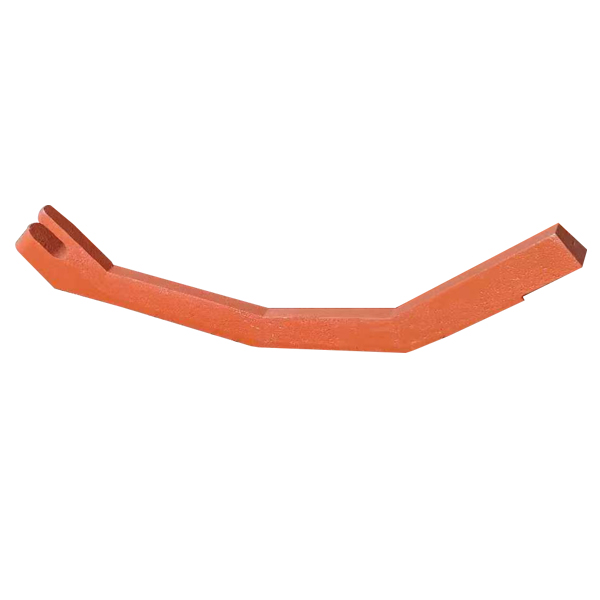
Grate Bar
Contact Us
Get a quote within 24 hours. Send us your inquiry today.

+86 199 8785 7268
Mon-Sat 8AM-10PM CST Scan to chat — English, Spanish, Chinese Send photos of worn parts for instant quote

+86 199 8785 7268
Scan to follow — factory updates and quotes Chat in Chinese or English