
One Trial, One Order: A Middle Eastern Cement Plant Switched Hammer Suppliers — And What It Took
2.5 months, 480,000 tons, a wear rate of 5.23 grams per ton. The numbers were good. But that’s not the interesting part.
The global cement industry churns out about 4 billion tons a year. China alone accounts for 1.9 billion of that, nearly half. Behind every one of those tons is a crusher, and behind every crusher is a set of wear parts that will eventually need replacing. The market for those parts is north of $22 billion annually, and a big chunk of it is hammers, liners, jaw plates — the stuff that takes the beating so the rest of the plant doesn’t have to.
For a 1 million ton per year plant, a single day of unplanned kiln downtime costs around $300,000. The crusher is the front door. When it goes down, the kiln doesn’t get fed, the preheater runs dry, and the whole line stops. Wear parts are maybe 5% of the procurement budget, but they control whether the plant runs or doesn’t. That’s a weird ratio. Most things that cost 5% don’t get to decide whether you lose $300,000.
I’ve been going through our test reports from the last few years and one keeps standing out. Not because the numbers were the best we’ve ever seen. Because of what happened after.
The trial: February to May, 2016
A cement plant in the Middle East was running bimetallic hammers from a European supplier. Performance was fine, nothing alarming, nothing great. We asked if they’d run a set of our insert bars hammers on the same machine, same limestone feed, same operating conditions. They agreed. These things happen slowly in this industry. A “quick trial” is two and a half months.
Middle East Cement Plant
Field Test
5.23 g/t
Wear Rate
0.42 L.E.
Cost Per Ton
~480,000 t
Total Throughput
1,000 t/h
Crusher Capacity
The trial results are better than the bimetallic hammers we previously sourced from Europe.
On a 1,000 ton per hour machine, 5.23 grams per ton means about 5.2 kilograms of hammer material wearing away every hour. Over 2.5 months, roughly 2.5 tons of material lost across the whole set. Spread across hammers weighing 135 kg each, that’s predictable degradation, not sudden failure. Nobody had to scramble for an emergency change-out.
What made the client act wasn’t the wear rate in isolation. It was the cost per ton: 0.42 L.E., lower than what they’d been paying. The math was simpler than most procurement decisions I’ve seen. They ran the numbers, the numbers were better, they placed the order. No three rounds of negotiation, no “send us your best price.” Just data.
I’ve been on both sides of these conversations — selling and buying — and the ones that close cleanest are always the ones where someone brings a test report instead of a brochure. The Middle East plant didn’t call references. They became the reference.
But the trial didn’t come out of nowhere. Before that first shipment, the client had already seen enough to feel comfortable saying yes. That part usually gets left out of case studies, and it shouldn’t.
The stuff that happens before a trial
The global crusher wear parts supply chain is messy. There are real foundries and there are trading companies that buy from foundries, mark it up, and ship it under their own name. From a buyer’s perspective, they look almost identical online. Both have websites. Both have catalog PDFs. Both answer emails.
What separates them isn’t something you can see on a screen. It’s whether they show up places where their product can be inspected in person, and whether there’s evidence they’re actually shipping volume.
Exhibition floors
We exhibit at international mining and construction machinery shows. Not every year, not every show, but enough that it’s a pattern. We bring full-size hammers and liners. Visitors check hardness with portable testers. They weigh parts. They take calipers to critical dimensions. This sounds like marketing but it’s the opposite. You can’t fake a Rockwell reading in front of someone.


Trading companies don’t do this. The cost of shipping 135 kg hammers to a convention center, renting booth space, staffing it for three days — it doesn’t make sense if you’re just reselling. The economics only work if you’re the manufacturer and the booth is part of your customer acquisition funnel.
Our Middle East client first saw us at an exhibition. They didn’t ask for a quote that day. They took measurements, asked some questions about the insert bars design, and filed it away. Months later, when their European supplier’s pricing crept up, they came back. The booth visit had already done half the sales work. The trial did the other half.
Packing bays
The other signal I’d tell any buyer to look for is what the shipping dock looks like. Not a staged photo of one box. Photos taken across different weeks, different shipments, different destinations. Real production leaves traces. Dust on the floor. Pallets stacked in the background. Different consignee marks on crates heading to different countries.

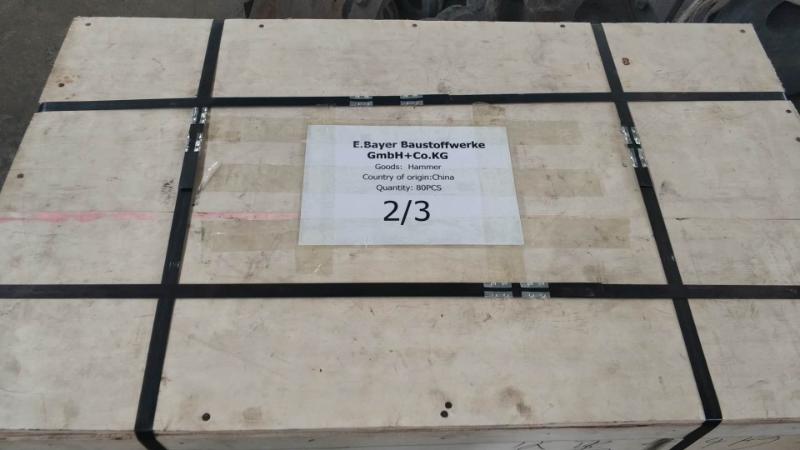

Consistent Marks
Labels and case markings that match the company name. Neutral boxes from consolidators are a red flag — they can hide anything.
Multiple Shipments
Photos from different dates showing different batches. A single glossy picture proves nothing — consistent supply requires evidence over time.
Different Destinations
Shipping marks for different countries. A manufacturer with diversified clients won’t vanish after one order — they have too much to lose.
Factory visits
We’ve had clients from several countries come to the foundry. They walk through the casting floor, check the heat treatment furnaces and the temperature charts that go with each batch, watch the spectrometer run. I don’t think every buyer needs to do this. But the fact that some do, and that we say yes without hesitation, matters. A supplier that can’t host a visit or at least do a video walkthrough of their production line is almost certainly not the manufacturer they claim to be.


The cost nobody calculates
I see the same mistake over and over. Procurement teams compare wear parts on purchase price. That’s like comparing cars on sticker price while ignoring fuel consumption, insurance, and maintenance. You’re measuring the smallest number and calling it a decision.
Wear parts eat up 40 to 60 percent of the operating cost of a crushing line. Not the purchase cost. The operating cost — the thing that recurs every month, every campaign, every change-out. And the formula that actually matters is:
(purchase price + downtime cost + labor) ÷ total throughput = real cost per ton
Downtime cost is the one most plants ignore, and it’s the biggest number. For a mid-size cement plant, every hour of unplanned crusher downtime costs $5,000 to $8,000 in lost production. Planned change-outs take 8 to 12 hours. Emergency change-outs take 12 to 24. The gap is a whole shift of production, sometimes more, and it’s entirely avoidable if you know when your wear parts are going to need replacing.
For limestone, cone crusher liners typically last 1,500 to 4,000 hours. Jaw liners run 800 to 1,200 hours. These ranges come from Sandvik’s Quarry Academy and the Metso Crushing Handbook, and they vary based on silica content, feed size, and whether you’re running manganese steel or high-chrome iron. But the range isn’t the point. The point is you can predict it. And if you can predict it, you can schedule around it.
Our Middle East client figured this out. After the trial, they knew exactly how long a hammer set would last on their machine with their feed. They could plan change-outs, order ahead, and avoid the emergency surcharge that comes with “we need it next week.” The lower cost per ton was nice. The predictability was probably worth more.
Three questions to ask any supplier
If you’re evaluating a crusher wear parts supplier and you don’t want to get burned, here’s what I’d ask:
1. Show me a field test with real numbers. Not a testimonial. A test report with crusher model, feed material, trial duration, throughput in tons, and wear rate in grams per ton. If they can’t produce one, there’s a reason.
2. Show me production volume. Exhibition photos, packing-bay shots from multiple dates, factory visit pictures. A supplier with nothing to hide will have these. A supplier that sends you one glossy warehouse photo taken three years ago probably doesn’t have a warehouse.
3. Let me run a trial on my terms. The suppliers worth working with will agree to a controlled test on your machine with your feed. They’ll also tell you what their product isn’t good for. Someone who says “it works for everything” is either lying or doesn’t understand their own product.
Most of the bad procurement decisions I’ve seen in this industry weren’t caused by bad products. They were caused by bad information. Someone compared three PDFs, picked the cheapest, and hoped. That’s not a strategy. That’s a bet.
FAQ
-
01
What’s an insert bars hammer?
An insert bars hammer is a high-performance crusher wear part designed for hammer crushers in cement and aggregate plants. It features a tough steel body with strategically placed, wear-resistant alloy inserts cast into the striking face. Unlike standard manganese or bimetallic hammers, the insert bars design delivers dramatically lower wear rates per ton of material processed — often 5× the service life — making it the go-to choice for operators who track cost per ton rather than upfront price.
-
02
How long should a hammer trial run to mean something?
At least 8–12 weeks of continuous production, processing tens of thousands of tons of material. Anything shorter is a snapshot, not a test. A meaningful trial needs to cover variations in feed size, moisture, abrasive silica content, and operator habits. We’ve seen hammers that held up beautifully for the first three weeks and then fell off a cliff — because the inserts weren’t deep enough. Duration matters. Throughput matters. One without the other tells half the story.
-
03
How do I know if a Chinese crusher parts supplier is real?
Three tests that cost you nothing. First: ask for photos of shipments to different countries with visible shipping marks. A real exporter ships globally; a trading desk reuses the same three photos. Second: ask for trial data showing complete hammer life, not just the first 30 days. Third: ask for a video call showing their factory floor with that day’s newspaper or a timestamp. If they hesitate on any of these, you’re talking to a middleman, not a manufacturer. Real suppliers are proud of their facilities and transparent about their track record.
-
04
What’s the real cost of getting wear parts wrong?
It’s never just the part price. Every premature hammer failure triggers a chain reaction: 4–6 hours of unscheduled crusher downtime, lost clinker production worth far more than the hammer itself, emergency labour at overtime rates, and risk of secondary damage to the rotor, breaker plates, and screens. A failed trial can also poison your procurement team’s willingness to try anything new for years. The “cheapest” hammer almost always carries the highest total cost. That’s why smart plants evaluate wear parts on cost per ton of throughput — not cost per kilogram.
Run Your Own Trial
Send your crusher model, feed material, and current wear rate. We’ll recommend a product and ship a trial set.
You track the numbers. If the hammers don’t outperform what you’re running now, you don’t reorder — no strings, no minimums, no obligation. We put the product where our mouth is.
CONTACT US